I had a plan. The plan was to print cable clips, a spare bracket for the shelf, and one small organizer for the junk drawer. This was a good plan. A rational plan. The print farm of useful household items would hum along tidily, and the printer would justify its own shelf space through pure utility.
Then I printed a Flexi Rex. The plan was immediately over.
If you are reading this before you print your first articulated animal, I want you to know that you are about to enter a phase. All printers go through it. Some printers never leave. What follows is a guide to doing it well.
DUMMY 13
Let me start with the one that takes the most shelf space.
DUMMY 13 Printable Jointed Figure by soozafone on Printables is a fully poseable jointed figure with 27 articulated parts. Every joint prints separately and clicks into place. Once assembled, it holds poses, has expressive hands, and responds well to being given tiny props from other prints. It is, in short, the kind of model that turns a 3D printer into a very slow toy factory.

The figure ships with files that are well enough tested to print without drama. A standard-size run takes most of a day. You can do something useful with those hours, or you can check on it every forty minutes. In my experience, most people check on it every forty minutes.
The Flexi Rex
Flexi Rex with stronger links by DrLex on Thingiverse is one of the oldest and most-saved articulated models in the catalog. The "stronger links" in the title are genuinely earned: this is a remix of the original Flexi Rex that replaced the joints with a design that survives being picked up and flexed repeatedly, rather than one print session. It coils, it flops, it sits on a desk with the unmistakable presence of a small plastic dinosaur.

Print it in one go: no supports, no hardware, no assembly. The hinges release from the bed in one piece. If you have time for one print-in-place model before trying anything more complicated, start here.
Something mechanical
Watch Escapement Desk Toy by LarkysPrints on Thingiverse is a different kind of satisfying. It is a scaled mechanical escapement, the click-and-release mechanism at the heart of a mechanical watch, printed in plastic and sized up to desk scale. You push the balance wheel, the pawl engages the escape wheel, and it ticks and releases.

There is no practical purpose here, which is entirely the point. If you have ever wondered why mechanical watches tick rather than sweep, this will explain it in about two minutes of hands-on fiddling, which is faster than a Wikipedia article and considerably more satisfying than reading either. Time well spent, I would say.
The fidget cube
Kobayashi Fidget Cube - Fat Hinge - Flat by markinthebox on Thingiverse is the definitive 3D printed fidget cube. The original Kobayashi design is a set of hinged panels that fold around a central cube, collapsing and opening continuously. The "fat hinge" version is more tolerant of print variance: the hinges are thicker, so they close cleanly and do not snap from stress after a week of daily use.
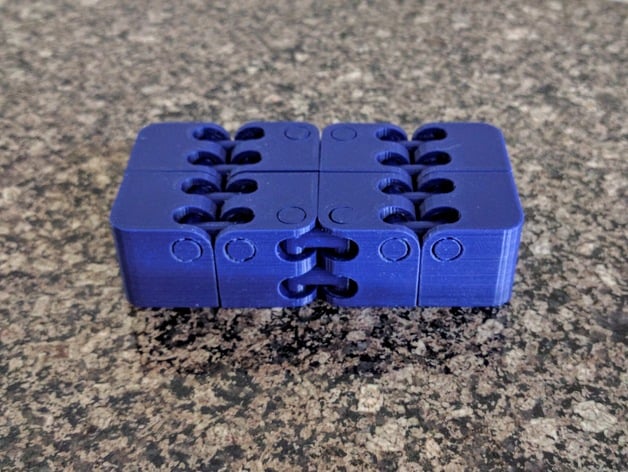
It has been remixed more times than almost any other fidget model in the catalog. The core design is a decade old and still the best version of this mechanism in free plastic. Print it in two contrasting colors if your printer handles filament changes: the visual makes the folding motion much easier to follow.
The small one
Cute Mini Octopus by McGybeer on Printables is for the person who wants something desk-sized without committing to a full afternoon of printing. It is small, it is print-in-place, and each tentacle flexes independently. The default size prints in under an hour on most FDM machines. At 150 percent scale it takes up exactly the right amount of space on a windowsill. At 200 percent it becomes a statement.

Print it in whatever is on the spool. The color does a lot of the work. So does having eight independently poseable tentacles.
A practical note
All five of these print on any standard FDM printer. None requires supports; all but the DUMMY 13 are print-in-place or single-piece builds. Before you load the file, the print cost calculator will tell you how much filament each takes: the mini octopus at default size uses almost nothing, and the DUMMY 13 across its 27 parts adds up fast if you are not careful about scale.
Thinger's fidget toys collection has 40 models in this category, ranked by how often people save them. If none of these is exactly right, there are another 35 in the list.
The free Thinger app searches across 600,000 free models from Thingiverse, Printables, and MakerWorld. Search "fidget", "flexi", or "articulated" and you will find something worth printing. Probably more than one thing. The plan was cable clips. It always starts with cable clips.