The fastest way to make a wargame table look good is to own fewer, better pieces. I believe that, and I also think it is expensive advice. Printing your own terrain changes the maths entirely: a piece costs filament and patience, and you can make as many as you like.
Here is the part I wish someone had told me sooner, though. Most of us print terrain in the wrong order. We start with the fiddly, beautiful centrepiece, and end up with one gorgeous ruin sitting in the middle of an empty green mat. A table does not read as finished because one model is spectacular. It reads as finished when the space is properly broken up.
So this is a build order rather than a top ten. Big blockers first, scatter second, tokens last.
Start with the things that block line of sight
Big, boring, blocky pieces are what make a table playable. They give your models somewhere to hide and they give the game its shape.
Warhammer 30K / 40K - Terrain - Crates / Pallets / Defenses by SnowMan77 (Thingiverse) is exactly the sort of thing I mean. Crates, pallets and defensive barricades: none of it is glamorous, all of it is useful. Print a pile, scatter them in threes, and suddenly the middle of your board is a place worth fighting over instead of an empty rectangle.
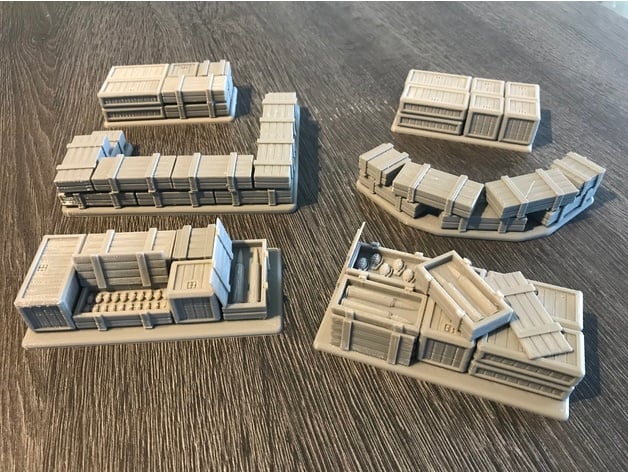
Tech Terrain by Scudjuice (Thingiverse) covers the sci-fi end of the same job. Industrial shapes read as "somewhere in the far future" without you having to paint anything clever, which suits me, because I am not clever with a brush.

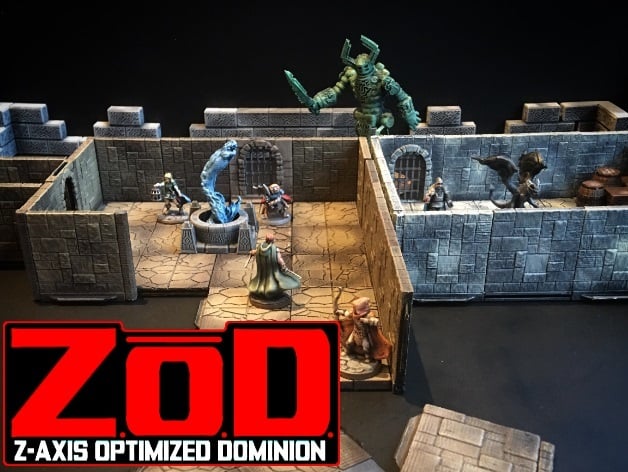
If you would rather build the ground itself than the things standing on it, Z.O.D. Terrain Tiles (Core Set) by dutchmogul (Thingiverse) is a modular tile system. Tiles are a bigger commitment in filament and time, but they change the whole table rather than decorating it, and you can keep adding to the set forever.
Then fill the gaps with scatter
Once the big shapes are down, the table still tends to look a bit staged. Scatter is what fixes that. Small, quick, slightly irregular pieces stop everything looking deliberately placed, which is funny, because you are placing them deliberately.
Tree Stumps (Scatter Terrain) by Jeremy8077 (Thingiverse) is my favourite kind of print for this. Stumps are small, they need no support, and nobody has ever looked at a stump and thought it was the wrong shape. Print a dozen over an evening and sprinkle them about.

Tokens are where printing really pays off
Here is my genuine opinion after far too many game nights: tokens are the best value print in the entire hobby. They are tiny, they are fast, and you always need one more than you have.
Life (or anything) counter for table-top games by Scottimus (Thingiverse) is a dial counter that will track whatever you point it at: wounds, command points, objectives, how many biscuits everyone has had. It replaces the handful of dice you are currently using as counters and then losing under the sofa.

If you want more in this vein, the wargame tokens and markers collection gathers the objective markers and counters together, and miniature bases covers the other small stuff that quietly makes an army look finished.
One detour, because it is nearly October
Halloween is about seven weeks out, which is exactly the right distance to start printing for it. Tabletop and spooky season overlap beautifully, and a themed one-off piece gives a regular table a bit of an occasion.
Wraith - Tabletop Miniature by Yasashii (Thingiverse) is a good example. It works as a monster in a normal game and as a centrepiece in an October one, so it does not become a decoration you store for eleven months.

Mimic - Toothy Treasure Chest - Tabletop Miniature by Yasashii (Thingiverse) is the same idea with better teeth. A chest that is pleased to see you. There is more in this direction in the Halloween 2026 collection if you want to lean into it properly.

Two things worth checking before you commit
Terrain is bulky in a way that miniatures are not, and filament cost adds up quicker than you expect across a whole table. The print cost calculator will give you the real number from weight and print time before you start a twelve piece set rather than after.
The other one is size. Big terrain is exactly the category most likely to not fit your build plate, and finding that out in the slicer is a dull way to spend an evening. The bed size checker will tell you whether a piece fits, how to orient it, and how far you can scale it.
Then it is just a matter of deciding which bit of the table to build first. My advice, for what it is worth, remains the boring one: crates before castles.
You can browse the full Kill Team and wargame terrain collections on the web, and the free Thinger app lets you search across more than 600,000 free models from every major platform and save the ones you want to a print queue.